
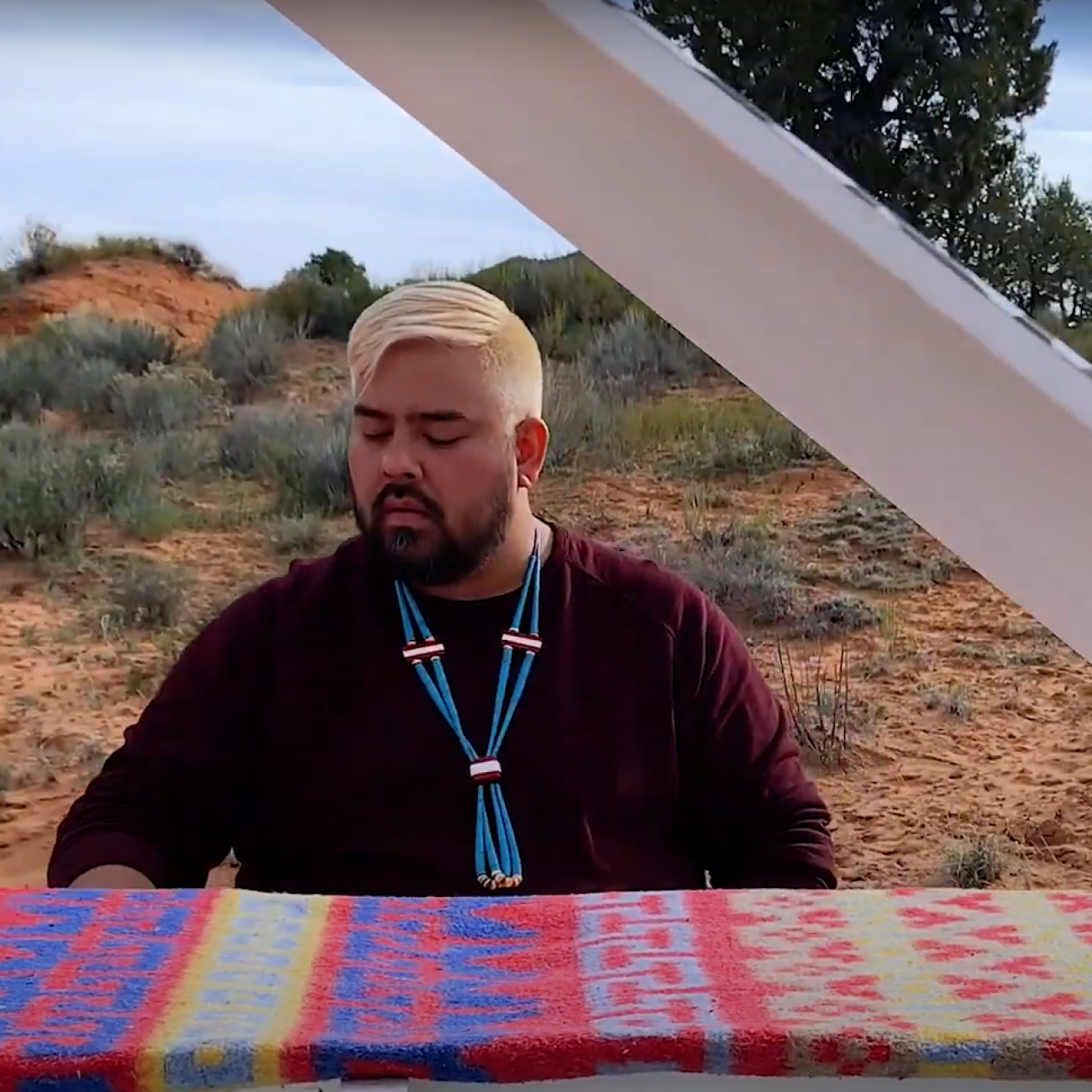


“Traditional Diné (Navajo) chants were used as sources of inspiration for these piano compositions, which were originally released on Connor Chee’s album The Navajo Piano in 2014. These pieces draw from the rhythms, forms, melodies, and methods of development used in traditional Navajo music. Some of the pieces are close transcriptions of the songs, while other pieces focus only on elements such as rhythm and recurring melodic patterns. The Navajo Vocables for Piano, composed in 2014, are based on traditional Navajo Corn Grinding Songs, as well as chants from the Navajo Enemy Way Ceremony. The term “vocables” refers to the non-lexical syllables used in Indigenous chants to carry melodic lines. In this collection, the vocables have been transferred to the piano, bringing what was once a strictly oral tradition to a new outlet. The Navajo Vocables for Piano were composed as three sets of four. The first and last sets (numbers 1-4 and 9-12) are based on Navajo Corn Grinding Songs, while the middle set (numbers 5-8) is based on songs from the Navajo Enemy Way Ceremony. In this sense, the Navajo Vocables for Piano can be performed as a complete set in 3 movements.
Navajo pianist and composer Connor Chee (b. 1987) is known for combining his classical piano training with his Native American heritage. Chee made his Carnegie Hall debut at the age of 12 after winning a gold medal in the World Piano Competition. A graduate of the Eastman School of Music and the University of Cincinnati’s College-Conservatory of Music, Chee’s solo piano music is inspired by traditional Navajo chants and songs.
Chee has released 4 studio albums of original pieces and piano transcriptions of Navajo music. The Navajo Piano won Best Instrumental Recording at the 16th Annual Native American Music Awards, and his piece “Beginnings” won Best New Age Song.”
-Connor Chee (www.connorchee.com)
Leave a Reply