
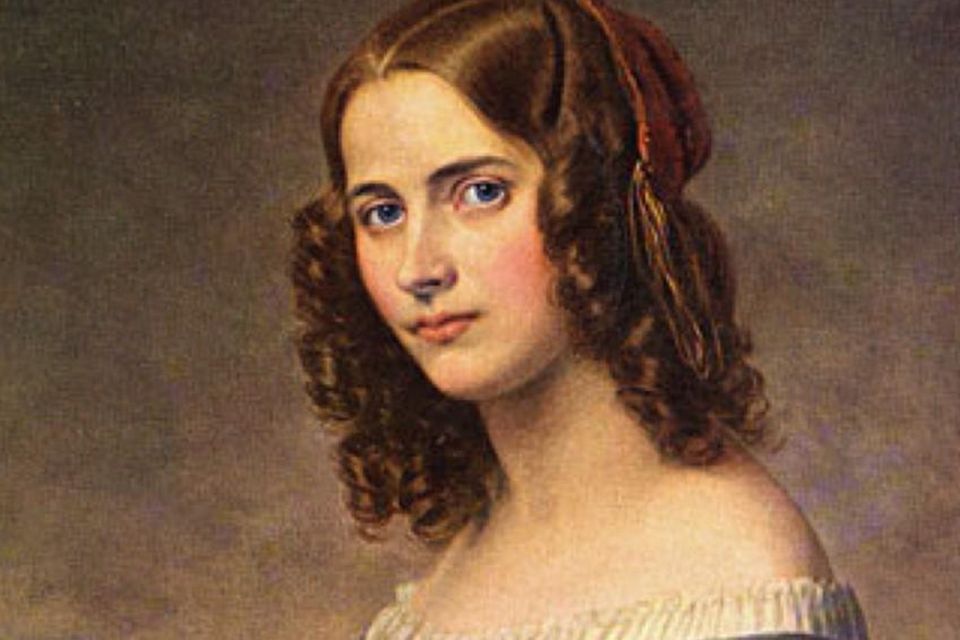


Performance: Sharon Prushansky, fortepiano, Basel 2020
Fanny Mendelssohn-Hensel’s Das Jahr, or The Year, is a series of 12 pieces for solo piano characterizing the 12 months of the year written in 1841. However, the work was never published until many years later, in 1989. The piece December represents the Protestant celebration of Christmas. Its blizzard-like opening gives way to a gentle Christmas hymn, “Vom Himmel hoch, da komm ich her” (From the heavens above, I come from) written by Martin Luther.
Information on Das Jahr:
“Das Jahr (German for “The Year”) is a groundbreaking cycle of 12 solo piano pieces characterizing the 12 months of the year plus a short postlude, composed by Fanny Mendelssohn Hensel in 1841 and revised in 1842.
Das Jahr (H385) is arguably Hensel’s greatest work. It was not published during her lifetime, though she did include one piece (September) as one of four pieces in her first opus of piano music, but without the title or subtitle (“By the river”). The manuscript was rediscovered in 1989, almost 150 years after it was written.
According to Hensel’s biographer R. Larry Todd, the cycle examines the passing of time:
natural time, marked by the changing of the seasons and measured by the secular calendar;
spiritual time, with chorales central to Protestant celebrations of Easter (March), Christmas (December), and New Year’s Day (Postlude);
family time, marked by life events and personal relationships, constructed around some musical themes borrowed from her brother Felix;
and dream time, with shifting tempi and evocative imagery, and an opening piece subtitled “A dream” (January).”
– HenselPushers.org
“The delightful set of 12 character pieces for piano, Das Jahr, by Fanny Mendelssohn Hensel, first published in 1989, has been given new life through Furore’s 1998 modern edition based on the more recently discovered fair copy prepared by the composer. What is equally celebratory is the pairing of this edition with the facsimile of the fair copy. Composed by Fanny Hensel in 1841, the year after her extended Italian trip with her husband and son, this set of 12 character pieces – one for each month of the year- offers some of Hensel’s finest, most sparkling piano composition. The composer described them thus, ‘Now I’m doing another little piece of work that gives me a lot of fun; it’s a series of 12 clavier pieces which shall symbolize the 12 months of the year.’
Well suited to the salon venue that Fanny Hensel presided over at Elternhaus in Berlin during the 1840’s, this piano cycle offers a marvelous variety of styles, techniques, and expression. Firmly in the Mendelssohn tradition of piano composition, it includes heartfelt lyrical melodies, dramatic dialogue, and scherzos, as well as frequent arpeggiation. Virtuosic passages lie easily in the hand, just enough to challenge the pianist, yet not overtax.”
– Furore Verlag
Information on Fanny Mendelssohn-Hensel:
“Drawn together by their shared love of music and exceptional talents, Felix Mendelssohn and his older sister Fanny (1805-1847) developed a close relationship that was to endure throughout their lives. While Fanny’s gender prohibited her from enjoying the same social opportunities or support in developing her musical gifts, her talents appeared to be nearly as formidable as those of her more famous brother. The fact that from very early in their lives, and until Fanny’s death (she died only six months before her brother), Felix would regularly submit his compositions to Fanny’s discerning musical eye and ear, taking her critical advice to heart, and never hesitating to modify or excise entirely material that she found questionable. Felix began to refer to his older sister as “Minerva,” the Roman goddess of wisdom, for her highly developed musical and intellectual insight.
Both of Mendelssohn’s parents — his father, Abraham Mendelssohn (1776-1835), and his mother Lea Solomon Mendelssohn (1777-1842) — were cultured individuals who played an active role in the education of their children. Young Felix and his siblings received a broad education — initially from both parents, and only later by tutors — in French, German, Latin, Greek, arithmetic, geometry, geography, literature, music theory, violin, and drawing. Their parents’ encouragement in developing their children’s rich cultural and intellectual lives reflected the esteem with which the value of education was regarded in the Mendelssohn household. The intellectual rigor of the children’s education also instilled in them a life-long discipline that allowed them to explore their creative activity — the products of which, especially in the case of Felix and his sister Fanny, far exceeded the norm.
Both Fanny and Felix made striking progress in their musical and general studies, and astonished those who heard them perform by their prodigious musical technique. By 1818, both children had begun producing their first compositional efforts; in the same year, both appeared as performers before audiences: the nine-year-old Felix in public concerts, as a soloist in J. L. Dussek’s “Military” Concerto, as well as an accompanist in a trio for two horns and piano by Joseph Wölff; and the twelve-year-old Fanny, who, before a private audience, demonstrated the remarkable feat of performing twenty-four preludes from J. S. Bach’s Well-Tempered Clavier from memory. (Her only documented public performance did not take place for another twenty years — until February 1838, when she performed her brother’s First Piano Concerto for a charity benefit.)
Fanny’s own virtuosity on the piano evidently equaled, if not surpassed, that of her brother Felix. But if Fanny might have had musical aspirations of her own, to pursue a life as a performer and composer as her brother did, such hopes were quickly dashed: societal constraints at the time precluded women from pursuing musical professions. This harsh reality was made clear by Fanny’s father Abraham in an 1820 letter to her, in which he states that while music will perhaps become Felix’s profession, “for you it can and must only be an ornament, never the basis of your being and doing.” While the following year Fanny met and fell in love with painter Wilhelm Hensel (1794-1861), whom she eventually married in 1829, and subsequently settled into the “acceptable” domestic roles prescribed by society of the time, her musical creativity continued to manifest itself in the prolific creation of over five hundred musical works, consisting mostly of the more intimate, ostensibly “feminine,” smaller scale genres of keyboard pieces, songs (of which she wrote over two hundred fifty alone), chamber music and choral works.”
– Library of Congress
Leave a Reply