


Performance: Reginald Mobley, countertenor; Henry Lebedinsky, piano
Sweetest bard that ever sung,
Nature’s glory, Fancy’s child;
Never sure did witching tongue
Warble forth such wood-notes wild!
Come each Muse, and sister Grace,
Loves and Pleasures hither come;
Well you know this happy place,
Avon’s banks were once your home.
Bring the laurel, bring the flow’rs,
Songs of triumph to him raise;
He united all your pow’rs,
All uniting, sing his praise! Text: David Garrick (1754)
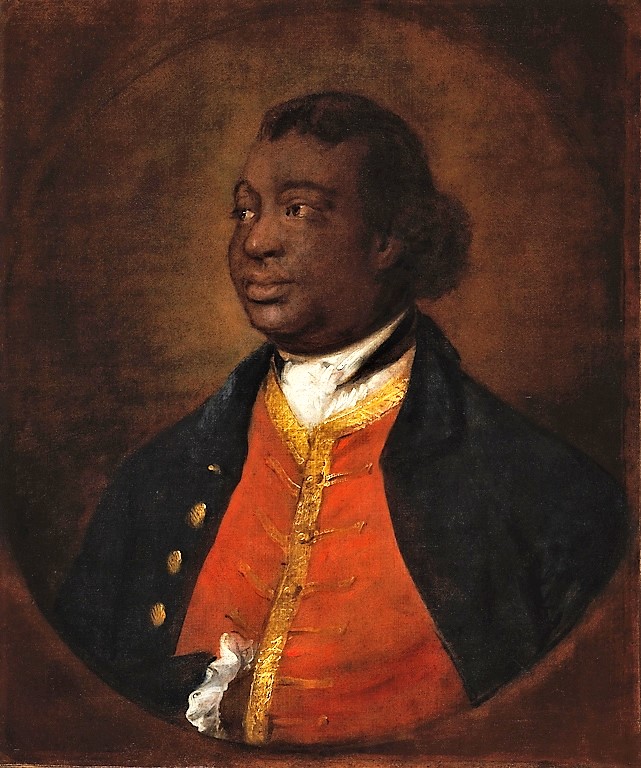
“Charles Ignatius Sancho (1729–1780) is remembered by the British Library as a “writer, composer, shopkeeper, and abolitionist.” We know a great deal about his life from his letters, with further details provided by a 1782 biography. According to this account, Sancho was born on a slave ship sailing from Guinea to the port of Cartagena in the Spanish West Indies (modern Colombia), though Sancho himself believed he had been born in Africa and taken to South America as an infant.
He was soon orphaned and then brought to England, where he was enslaved in Greenwich, London, by three sisters who opposed any attempt at education. Soon, however, Sancho drew the attention of John Montagu, a duke and family friend, who gave Sancho books and encouraged his intellectual aspirations, defying the house rules.
After Montagu’s death in 1749, Sancho fled enslavement and was hired by Montagu’s widow as a paid butler. In his free time, he read from their library. After the duchess’s death two years later, Sancho attempted an acting career, appearing in Shakespeare’s Othello and as the African prince Oroonoko in a stage adaptation of Aphra Behn’s novella. However he could not support himself, and so returned to the Montagu house where he resumed work as a domestic servant for another 20 years.
While continuing to work in the Montagu residence, Sancho composed songs, minuets, and country dances, which may have been performed at social gatherings of Black domestic workers. He self-published his pieces in four volumes between 1767 and 1779. On each cover he emblazoned, “Composed by an African.”
Sancho struck up a correspondence with the prominent author Laurence Sterne (1713–1768) and asked for his help in advancing the abolitionist cause. He recognized that influencing the views of the educated class would be more effective than trying to change the minds of slaveholders, so he asked Sterne to depict the cruelty of slavery in his popular fiction, noting “that subject, handled in your striking manner, would ease the yoke (perhaps) of many.”
Sterne agreed, replying, “it casts a sad Shade upon the World, That so great a part of it, are and have been so long bound in chains of darkness & in Chains of Misery.”
Sancho left the Montagu house for good in 1773 and opened a grocery store in Westminster, London, the following year. As a property owner, he was eligible to vote, and he became the first known person of African descent to do so in England. Upon his death in 1780, he also became the first known person of African descent to receive an obituary in an English newspaper. Two years later, his friends and family published a collection called Letters of the late Ignatius Sancho, an African, which furthered support for abolitionist movement, which culminated in Britain with the 1833 Slavery Abolition Act.”
Leave a Reply