
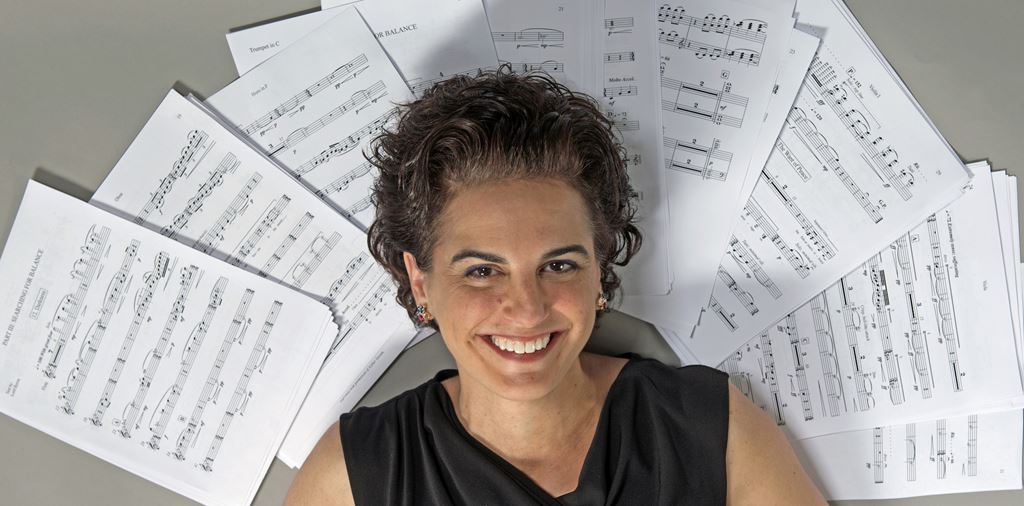


Performance: CCPA Symphony Orchestra, conducted by Alondra de la Parra
About Mythology Symphony:
“The sounds and stories of Stacy Garrop’s Mythology Symphony (2007-2013), recently recorded and released by Cedille Records, are familiar yet have been both texturized and contextualized in new ways. The Mythology Symphony is here presented alongside two other orchestral works, Thunderwalker (1999) and Shadow (2001), all of which weave musical structure with ‘direct and dramatic narrative,’ which Garrop states on her website is one of her primary compositional concerns. Taking gods, goddesses, histories both personal and legendary, and themes such as ritual and death as her subject matters, Garrop achieves drama through narrativity that is not altogether direct. Rather, the instruments and melodies, embodying the voices of mythic figures, at times take on a robustly human quality much like these gods themselves, echoing as they do in human form across time and the cultural consciousness. Although Garrop is quite direct in the accomplishment of her authorial intentions, there is still enough mystery to intrigue one’s ear.
During ‘Becoming Medusa,’ the first movement of Mythology Symphony, Medusa is personified by a piercing solo violin. Rather than following Medusa’s story linearly across time, Garrop opens with layers of clamoring dissonance indicating Medusa’s eventual fate but quickly leaps backwards to the beginning of the story: long before Perseus is sent to cut off Medusa’s head, Medusa is initially a beautiful woman. She makes the mistake of seducing the god Poseidon in Athena’s temple, incurring Athena’s wrath and resulting in her transformation into a terrifying Gorgon with snakes for hair. The narrative is represented musically with recurrent violin solos that interact with the forces centered around Medusa’s fate—forces that are personified by the startlingly crisp CCPA Symphony Orchestra, conducted by Alonda de la Parra. Medusa’s accompaniment roils and simmers in Sibelius-esque currents, cascading and ebbing through cinematic flashbacks and towards the middle getting interrupted by a percussion and wind interlude. The folksy repetitions sashay their way across the orchestra sections and onwards towards the layered, blustering reentry of the full ensemble.
This movement, composed initially as a commission for the Detroit Symphony, was followed by four more over the next six years. The first of these is ‘Penelope Waits,’ during which the CCPA Symphony Orchestra has been pared down to a sparse chamber ensemble, and the oboe representing Odysseus’s wife Penelope sings plaintively above them. The drastic shift from Medusa’s cacophony to the lyrical, introverted musing of Penelope exhibits Garrop’s knack for a sort of disjointed drama that easily snatches the listener into its non-teleological thrust. ‘The Lovely Sirens,’ ‘The Fates of Man,’ and ‘Pandora Undone’ complete the collage of musicalized mythologies, wrenching the listener from Penelope’s quiet waiting period through the ruination of a pack of raucous sailors as they become enchanted by the Sirens’ song, the slow death of a man appealing to the three Sisters of Fate, and the mysteries enclosed within Pandora’s box. Presented as a five-movement whole, the work is nothing if not dramatically propulsive.”
– I Care If You Listen, powered by American Composers Forum
About Stacy Garrop:
“Stacy Garrop’s music is centered on dramatic and lyrical storytelling. The sharing of stories is a defining element of our humanity; we strive to share with others the experiences and concepts that we find compelling. Stacy shares stories by taking audiences on sonic journeys – some simple and beautiful, while others are complicated and dark – depending on the needs and dramatic shape of the story.
New Music USA and the League of American Orchestras have chosen Stacy and the Champaign-Urbana Symphony Orchestra as one of five orchestra/composer pairings for Music Alive’s 2016-2019 residence program. She will also serve as the inaugural Emerging Opera Composer for Chicago Opera Theater’s new Vanguard Initiative in 2018-2020. Theodore Presser Company publishes her chamber and orchestral works; she self-publishes her choral pieces under Inkjar Publishing Company. Stacy is a recording artist with Cedille Records; her works are also commercially available on nine additional labels.
Stacy has received the Barlow Prize, a Fromm Music Foundation grant, three Barlow Endowment commissions, and the Raymond and Beverly Sackler Music Composition Prize, along with prizes from competitions sponsored by the Detroit Symphony Orchestra, Civic Orchestra of Chicago, Omaha Symphony, New England Philharmonic, Boston Choral Ensemble, Utah Arts Festival, Pittsburgh New Music Ensemble, and Sorel Organization. She has participated in reading session programs sponsored by the American Composers Orchestra and Minnesota Orchestra (the Composers Institute).
Stacy’s catalog covers a wide range, with works for orchestra, wind ensemble, choir, art song, various sized chamber ensembles, and an evening-length oratorio. She has been commissioned and performed by the Albany Symphony and Minnesota Orchestra; by the chamber groups Capitol Saxophone Quartet, Gaudete Brass Quintet, and Kronos Quartet; and by the choirs Chanticleer, Chicago a cappella, Piedmont East Bay Children’s Chorus, San Francisco Choral Society, and Volti. Additional performances have been given by the Cabrillo and Grant Park Music Festival Orchestras; Amarillo, Charleston, Columbus, Illinois, Omaha, and Santa Cruz Symphony Orchestras; by Aspen Music Festival Contemporary Ensemble, Fifth House Ensemble, Lincoln Trio, and Voices of Change; and by Grant Park Music Festival Chorus and Voices of Ascension.
Stacy earned degrees in music composition at the University of Michigan-Ann Arbor (B.M.), University of Chicago (M.A.), and Indiana University-Bloomington (D.M.). She taught composition full-time at Roosevelt University from 2000 to 2016 before leaving to launch her freelance career.”
Leave a Reply