
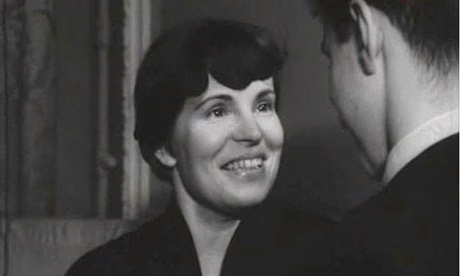


Performance: Gleb Kanasevich – reciter
Jacob Ashworth – violin
Arthur Sato – oboe
Miki Sasaki – trumpet
Andrew Madej – tuba
Doug Perry – “cube”
About Symphony No. 5, ‘Amen’:
“Writing symphonies in Moscow during the post-war era (1955‑90) implies a continuation of a central tradition which these works comprehensively and often aggressively reject. A more relevant approach might be via the contemporary art being made at the fringes of the Soviet Union: the music of Giya Kancheli in Tbilisi, for example; or of Valentin Silvestrov in Kyiv, before he went tonal; and most of all the ritualistic films of the director Sergei Parajanov, born to Armenian parents in Tbilisi.
As for Ustvolskaya: these symphonies express – to me – an oblique and personal relationship with Orthodox religion, and a rebellious resistance to Soviet authoritarianism and atheism. Jesus, Messiah, Save Us! is the subtitle of the Third, in the spirit of Psalm 51, the Miserere. In fact the impassioned reciters for both the Third and Fourth Symphonies intone an 11th-century hymn, against the backdrop of solemn instrumental chorales, versicles and refrains which correspond to the shape and harmony of Stravinsky’s late religious works such as the Requiem Canticles, and at their shared root, to the Symphonies of Wind Instruments. There is something ancient and immovable about this music, for all its apparent discontinuities and sometimes abrasive modernity (see again the comparisons with Kancheli and Parajanov). As sung by a treble in the second movement of the First Symphony, Ustvolskaya’s setting of a macabre-poetic children’s fable by Gianni Rodari even magically spirits us back to the world of The Firebird and The Rite.
Meanwhile, the Miserere looks for hope in the ‘sacrifices of righteousness’ demanding ‘bullocks upon thine altar’, and Ustvolskaya has frequent recourse to a kind of instrumental altar of her own, a wooden box which punctuates her syntax with tapping and thumping and (in the Second especially) full-on, Mahler-Sixth-style cracks. A personal but time-honoured refinement of symphonic style also plays out across the five works, as they place ever greater store by fewer and more isolated gestures: perhaps the only signal point of comparison with her one-time teacher, Shostakovich.
Bearing every sign of careful preparation, these performances make the most compelling case for Ustvolskaya as her own woman. The recording, too, is exemplary in capturing the required range of volume and intensity without demanding adjustment on the listener’s part between (in No 4) a whispered solo voice or muted trumpet and earth-shaking gong strokes. The booklet prints both sung texts and translations, a picture of the big wooden box, and a good essay by Elena Dubinets.”
About Galina Ustvolskaya:
“The Russian composer’s brutally uncompromising work has an elementality that’s both horrifying and thrilling.
It has the ‘narrowness of a laser beam which is capable of piercing metal’; it’s a ‘voice from the ‘Black Hole’ of Leningrad, the epicentre of communist terror, the city that suffered so terribly the horrors of war’; it ‘burns … with an inhuman intensity and a spiritual strength, as though it his broken away from musical substance and exists independently, like radiation or gravity.’ Composers Viktor Suslin and Boris Tischenko are describing the power of the music of Galina Ustvolskaya, the Russian composer who died in 2006 having created one of the 20th century’s most brutally, brilliantly uncompromising corpuses of work. Ustvolskaya said she agreed with Schumann that ‘the best method of talking about music is to be silent about it.’ In her case, there’s a truth to that dictum because of her music’s sheer, brutalising power: it has a terrifying and transcendent physicality; the inescapability of an asteroid firing into earth; an elementality that’s both horrifying and thrilling; a sense of pain that becomes … – you see? Ustvolskaya is right of course: instead of all those adjectives and metaphors, listen to this piece …
Told you it was physical: it’s one of Ustvolskaya’s last works, her 6th Piano Sonata, composed in 1988. And if it’s an assault on the senses for you as a listener, that’s nothing compared to the painful physical process the pianist must go through to practise and then perform the fistfuls and armfuls of fffff tone-clusters that the piece demands (you can see how the piece is notated, too, on YouTube). In her fascinating book Performing Pain: Music and Trauma in Eastern Europe, musicologist Maria Cizmic says that this piece “opens up a performance space in which a pianist feels pain, foregrounding the concrete bodily acts and sensations of suffering at a time when the violence of the USSR’s past continued to be contested”. But the sonata isn’t just an incessant pianistic battering ram: in just seven minutes, the piece creates a gigantic drama, in which there’s melody – listen to the top notes of each of the hammered-out clusters; there are tunes in this piece, I promise – and a ferocious emotional concentration, embodied by the first performance indication, ‘Espressivissimo’ – as expressively as possible.
What the music expresses is something that you will decide for yourself, but there’s a rich historical context for how this music, and the rest of Ustvolskaya’s hyper-compressed, hyper-intense works (she acknowledged just 21 of them) came about – even if the music seems, when you hear it, to be as strange as a rock thrown from the moon. One of the clues is Dmitri Shostakovich, who proposed marriage to Ustvolskaya at least once.
Shostakovich would send Ustvolskaya his newest works for her approval, and over the years they played out a game of mutual musical tribute-making in a toing-and-froing of quotations based around a motive from the first, unpublished version of Shostakovich’s 9th Symphony (read Rachel Jeremiah-Foulds’s essay for a precise account of what happened to this melody in their music). But Ustvolskaya later fell out with Shostakovich and left the sphere of his influence – or anyone else’s, for that matter – to pursue her own compositional path without compromises, but without public acclaim, too.
Her music of the 1960s and 70s was composed largely without any support from the Soviet regime, and only with glasnost did her music again find a public in the late 80s. She was committed to the idea of composition as a spiritual, but not religious, activity: ‘The whole process of composition is accomplished in my head and in my soul’, she wrote. ‘Only I myself can determine the path of my composition. Lord, give me strength to compose! – I beseech Thee.’ It’s above all in her three ‘Compositions’ and five symphonies, each written for a frankly bizarre and sui generis instrumental and vocal lineup (the symphonies include parts for speakers, who declaim religious texts), where you hear that spirituality trenchantly, fervently, and apocalyptically expressed.
Take that ‘triad’ of three ‘Compositions’: the first, Dona Nobis Pacem, is written for piccolo, tuba, and piano, a combination that opens up abyssal gaps between the ranges of the instruments, sounding out a musical void into which the instruments seem to shriek and cry, hopelessly, for comfort. The second, Dies Irae, is scored for an even weirder ensemble of piano, eight double-basses, and wooden cube, a coffin-like instrument that is pitilessly pummelled by the percussionist as the basses grind away. The third part of the trilogy is a Benedictus for four flutes, four bassoons and piano, which creates a more reflective but no less bleak soundscape. This is musical spirituality that comes from an unflinching look into depths of human pain.
And yet Ustvolskaya’s music has, I think, a cathartic power. Just as it voices a ‘scream into space’ – words appended to the score of the Second Symphony, ‘True and Eternal Bliss.’ it exorcises primordial emotions of suffering and grief, and turns them into vivid, implacable creative expression. In a film made in Holland in 2005, the year before she died, Ustvolskaya spoke of the overwhelming loneliness she felt when she was writing the Second Symphony in the late 70s, and which she still feels at the end of her life. Ironically, it’s precisely because her music gives almost unbearably direct expression to this essential spiritual bleakness that it creates such an indelible but mysterious resonance in listeners today. Well, it does in me at least. Find out what you think as you experience the laser beams, black holes, and expressive radiation of Ustvolskaya’s musical world.”
Leave a Reply