
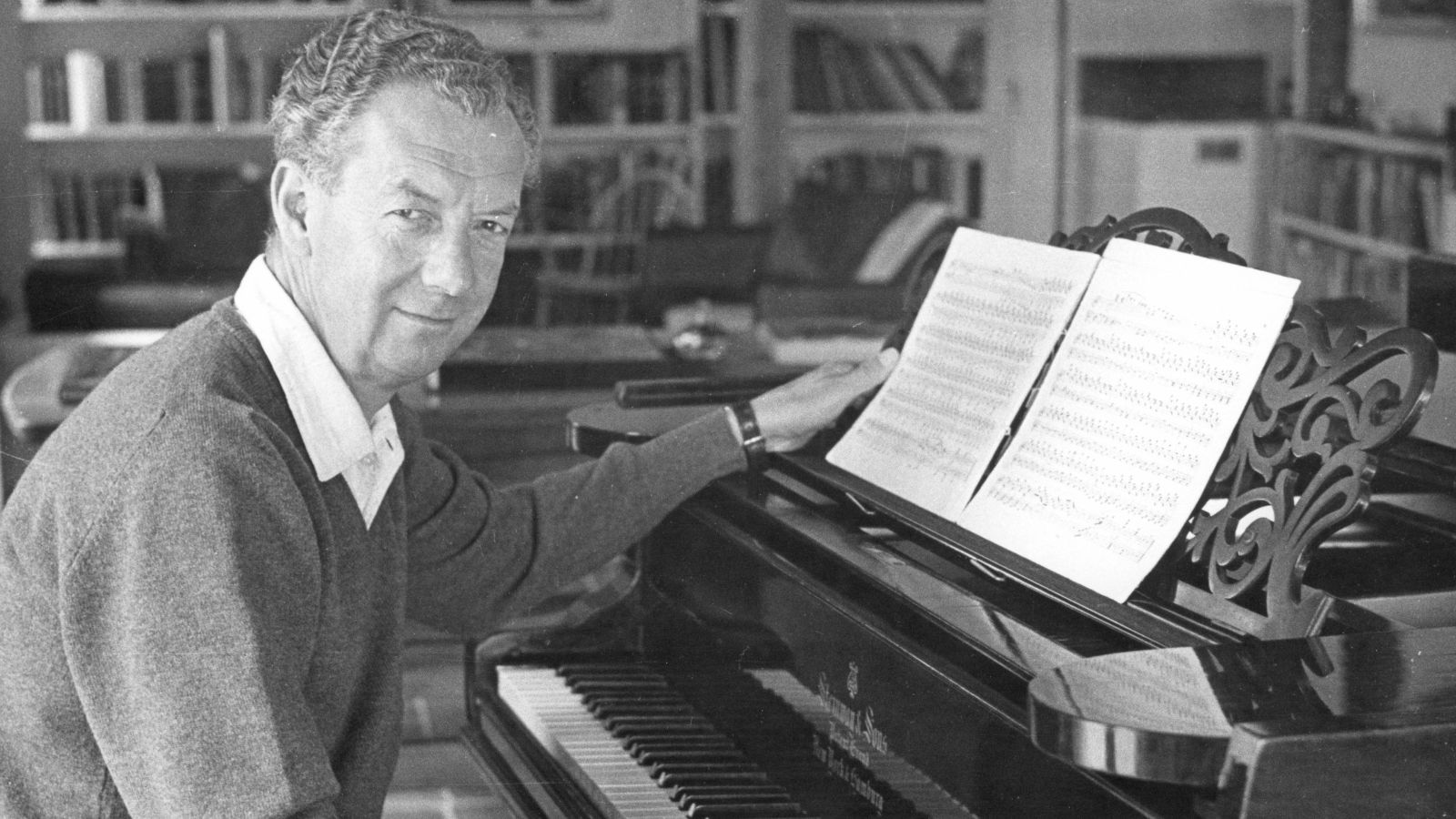


Performance: The Bach Choir, London Symphony Chorus, London Symphony Orchestra, conducted by Benjamin Britten
About War Requiem:
“Commissioned to celebrate the opening of the new cathedral at Coventry, built to replace the one destroyed by bombs, Britten used the opportunity to write a large-scale composition embodying his deeply held pacifist and humanitarian beliefs. The result, the War Requiem, is regarded by many as his masterpiece in the non-operatic sphere. Britten intersperses his setting of the traditional Latin Missa pro Defunctis with nine poems of the First World War poet Wilfred Owen, resulting in highly subtle and powerful contrasts and ironies. Written in a direct style, the War Requiem carries overwhelming conviction, and concert audiences the world over continue to respond to its timeless relevance.
In many ways this magnum opus, one of the 20th century’s defining works, was also Britten’s defining moment. Everything he believed in and stood for was writ large in this most fortuitous commission. Coventry had been almost obliterated by German bombs on 14 November 1940. The cathedral was destroyed although its fine tower and spire were miraculously saved. The inspirational decision was taken to build a new cathedral at right angles to the old and to connect them. The new building’s message was to be of reconciliation. A sacred ministry for reconciliation with international outreach was put in place and still partly defines the cathedral’s mission.
For a long time Britten had felt that the gap in his output was a major choral/orchestral work. He tried twice to encourage writers to give him a libretto which would fire his imagination. W. H. Auden and Ronald Duncan were both asked but although they tried neither could supply what he wanted. When Coventry mounted an Arts Festival to celebrate the dedication of its new cathedral in 1962 Britten was an obvious choice to ask for a major work. This, for Britten, was the opportunity for which he had been waiting. As a lifelong, passionate pacifist it was his opportunity to write a work which reminded its audience of the reason for the building of this new cathedral, but also, and far more importantly, to demonstrate in the most powerful way possible the horror, devastation, futility and utter waste of war.
His inspired idea was to mix the words of the Missa pro defunctis (Mass for the Dead) in Latin with the poems of one of the greatest of the First World War poets, Wilfred Owen. Owen was killed within days of the ending of those hostilities and this further emphasised Britten’s central theme of the criminal waste of human life in futile conflict. He uses nine of Owen’s poems which form a kind of song cycle which weaves in and out of the formal sections of the Latin Mass. Owen’s own statement: ‘My subject is War, and the pity of War. The poetry is in the pity…All a poet can do today is warn. That is why the true poets must be truthful.’ chimed perfectly with Britten’s own convictions and led to the writing of one of the most moving and personal works of modern times. The setting of the Latin Mass and the interspersing of solo song was a brilliant binding of public and private personas which hits the listener with extraordinary intensity.
So powerful was the first performance that The Times critic, William Mann, wrote: ‘so superbly proportioned and calculated, so humiliating and disturbing in effect, in fact so tremendous, that every performance it is given ought to be a momentous occasion’. It was a score which immediately captured the public imagination. Among 20th century British large-scale choral works only Walton’s Belshazzar’s Feast had previously caused the kind of stir which the War Requiem created. Walton’s theatrical histrionics and hire-wire excitement couldn’t fail to raise the gooseflesh. Here now, however, was a deeply spiritual work on the most serious subject which caught the national mood perfectly. When Britten’s recording was released the following year it sold 200,000 copies within the first five months which was almost unheard of for a classical work, and possibly unique for a large-scale contemporary one. This was the moment of destiny for which Britten had been preparing all his adult life. The peace movements of the 1960s, the Cuban missile crisis, nuclear testing, anti-nuclear protests, the war-weariness of the seemingly endless conflict in Vietnam, all these things contributed to the public’s readiness to hear this message which Britten so powerfully addressed. The fact that the original soloists were supposed to be from Germany, Britain and Russia further emphasised the message of reconciliation. The sad fact of Galina Vishnevskaya, the Russian soprano, being prevented from singing because she was refused permission by the Russian Minister of Culture, spoiled what would have been a truly historic cast of singers (the others were Peter Pears and Dietrich Fischer-Dieskau). But Vishnevskaya did come to record the work in 1963 with Britten conducting. Her place at the premiere was memorably taken by Heather Harper.”
About Benjamin Britten:
“Benjamin Britten was born in Lowestoft, Suffolk, on November 22, 1913. Although he was already composing prolifically from the age of seven, in 1928 lessons were arranged for him with the composer Frank Bridge; two years later he went to the Royal College of Music in London, studying with Arthur Benjamin, Harold Samuel, and John Ireland. While still a student, he wrote his ‘official’ Op. 1, the Sinfonietta for chamber ensemble, and the Phantasy Quartet for oboe and string trio, and in 1936 he composed Our Hunting Fathers, an ambitious song-cycle for soprano and orchestra, which confirmed his virtuosic vocal and instrumental technique. He was already earning his living as a composer, having joined the GPO (Post Office) Film Unit the previous year; the collaboration he began there with the poet W. H. Auden was to prove an important one for several years. In 1937, he first met the tenor Peter Pears, with whom he entered into the lifelong personal and creative partnership that was to become a major inspiration for his music.
Five months before the outbreak of World War Two, Britten and Pears travelled to the United States and stayed there for three years, returning to Britain in 1942. In America Britten wrote a number of important works, among them the Violin Concerto, the song-cycle Les Illuminations for high voice and strings, and the orchestral Sinfonia da Requiem. With the operetta Paul Bunyan, he also made his first essay in a genre that would be particularly important to him. Back in England, where as conscientious objectors both men were excused military service, Britten began work on the opera that would establish him as the pre-eminent British composer of his generation – Peter Grimes, premiered to an ecstatic audience reaction on 7 June 1945 with Pears in the title role.
The Young Person’s Guide to the Orchestra: Variations and Fugue on a Theme of Purcell – a cornerstone of the orchestral repertoire – was first performed in the following year. Britten now composed one major work after another, contributing significantly to symphonic, chamber and choral music but in particular to opera, through The Rape of Lucretia (1946), Albert Herring (1947), Billy Budd (1951), Gloriana (1953), The Turn of the Screw (1954), Noye’s Fludde (1957), A Midsummer Night’s Dream (1960), Owen Wingrave (1970–71) to “Death in Venice (1971-73), an operatic swansong summing up the conflict of innocence and corruption that obsessed him all his life. It is dedicated to Pears, who created the role of Aschenbach.
The importance of Britten and Pears in post-War British cultural life was enhanced by their involvement in the founding of the English Opera Group in 1946 and the Aldeburgh Festival two years later. Britten’s career as a composer was matched by his outstanding ability as a performer: he was a refined accompanist, especially in his partnership with Pears, and a fluent and authoritative conductor – his interpretations of Mozart were particularly highly esteemed.
All his life Britten suffered bouts of ill health and in 1973 he underwent open-heart surgery from which he never fully recovered. He died on December 4, 1976, at the age of 63, a few months after being created a life peer – the first composer ever to receive that honour.”
Leave a Reply