
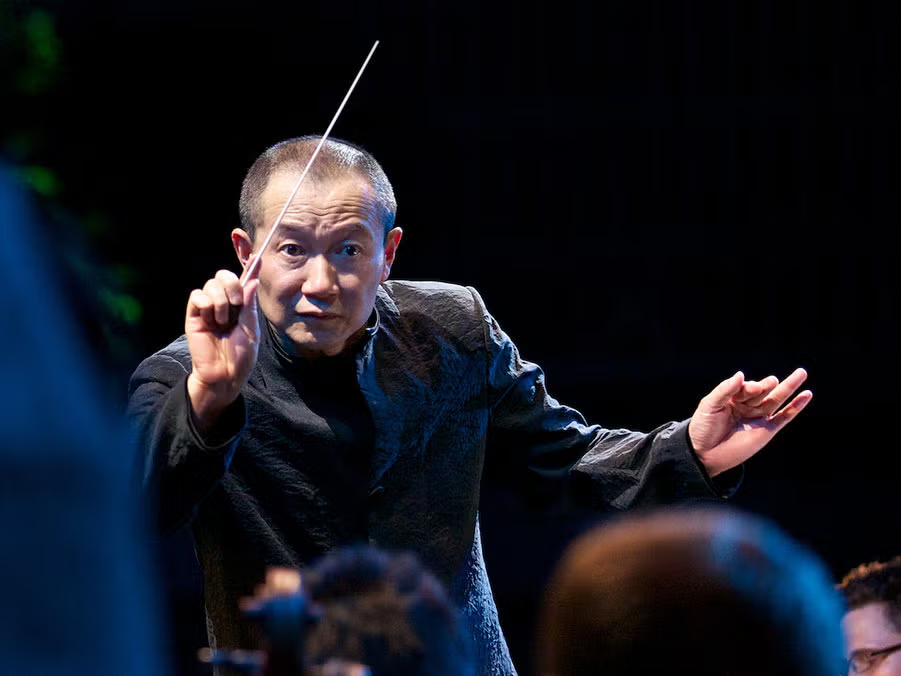


Performed by Eldbjørg Hemsing, violin, w/ Oslo Philharmonic Orchestra conducted by Tan Dun
About Violin Concerto “Fire Ritual”:
“The world premiere of Tan Dun’s Fire Ritual, a rhapsody for violin and orchestra written for Norwegian violinist Eldbjørg Hemsing, was the centerpiece of the Sept. 19 Oslo Philharmonic concert, with the composer conducting. Performed at the Oslo Concert Hall, it was part of Norway’s 10-day Ultima Contemporary Music Festival.
The musical relationship between Dun and Hemsing began in 2010 during World Expo in Shanghai, where Hemsing performed his 2009 violin concerto The Love with the Trondheim Symphony Orchestra. The Oscar-winning composer’s latest work is the result of a series of collaborations between the two artists invigorated by Hemsing’s devoted performances of his other violin concertos.
Fire Ritual is a bold statement that seeks to redefine the European concerto. Subtitling it A Musical Ritual in Memory for the Victims of War, Dun takes his inspiration from the royal court performances of the Tang Dynasty. He recast the ancient performance practice of two simultaneous orchestras – the full complement of the Oslo Philharmonic onstage and a small ensemble of wind instruments and brass strategically placed in various positions in the balcony.
As conductor, Dun bridged the worlds of humankind (orchestra) and mother nature (solo winds and brass). The antiphonal writing created a dialogue in four dovetailed chapters titled ‘Cruel Wars,’ ‘Innocent People,’ ‘Mantras of the Heavenly Birds,’ and ‘Eternity.’ The section titles suggest a continuation of Dun’s earlier musical evocations of earth, water, and transcendence; the new score is urbane, vociferous, at times contradictory, but always in perpetual motion.
Hemsing entered the stage from the audience. She was ushered in by a nurturing prologue from the woodwind soloists hovering above her. She rose from her seat, phoenix-like, with the offer of a single note – D natural. Hemsing imbued this one, inconspicuous note with a cornucopia of emotive colors and unorthodox bowing techniques.
Her first musical conversation developed with percussion, as a quartet of Peking Opera hand cymbals sparked and clapped accompanying rhythms like a Baroque ensemble. Dun’s thematic material for the soloist is inspired by the sliding, glissandi techniques of the traditional Chinese erhu and the tremolos of the guqin (Chinese zither).
In the section depicting war, Dun’s declamatory orchestral colors focused on explosive brass writing, particularly trombone, and his response from nature was a set of miniature tone poems of twittering bird calls created not only by the woodwind instruments but also by variously pitched bird whistles. The audience was enveloped in a multi-dimensional surround sound environment that was an eclectic mosaic of musical gestures. The motives were restless, impatient, fleeting. They darted throughout the auditorium from above and in front of us in quick succession – like images in an interactive video game.
Dun’s signature use of paper, rocks, and vocal whispers punctuated his score. As conductor, he vocalized ancient mantras, and the orchestra was also called upon to contribute to the theatrical experience. At one point, the orchestra created wind flourishes by turning the pages of their scores; at another they accompanied the solo violin by humming a hymn. They were active protagonists in this operatically inspired, hyperactive work that urges the audience to remain alert – a sort of FOMO (fear of missing out) moment in the concert hall.
Amid all this animation and east-west boundary crossing, Hemsing’s contribution remained poised. Her playing had a calming gravitas. Fire Ritual demands a different kind of virtuosity. The soloist is called on to create shimmering sustained sounds in the highest register and to act as a colorist. Hemsing delivered these divergent nuances perceptively. One might even wonder, given the specificity of the work and its inherent spirituality, if this concerto can be interpreted by a different violinist, with another orchestra, or without Dun as conductor. Has he written himself and Hemsing into every performance? Or are they the temporary custodians? I would have wished for more stillness, so that I could register the fleeting moments of beauty – to connect with the implied messages of mourning – but this clearly was not in Dun’s vision.”
– Classical Voice North America
About Tan Dun:
“Tan Dun is a Chinese-born American composer and conductor. A leading figure of contemporary classical music, he draws from a variety of Western and Chinese influences, a dichotomy that has shaped much of his life and music. Having collaborated with leading orchestras around the world, Tan is the recipient of numerous awards, including a Grawemeyer Award for his opera Marco Polo (1996) and both an Academy Award® and Grammy Award® for his film score in Ang Lee’s Crouching Tiger, Hidden Dragon (2000). His oeuvre as a whole includes operas, orchestral, vocal, chamber, solo and film scores, as well as genres that Tan terms ‘organic music’ and ‘music ritual.’
Born in Hunan, China, Tan grew up during the Cultural Revolution and received musical education from the Central Conservatory of Music. His early influences included both Chinese music and 20th-century classical music. Since receiving a DMA from Columbia University in 1993, Tan has been based in New York City. His compositions often incorporate audiovisual elements; use instruments constructed from organic materials, such as paper, water, and stone; and are often inspired by traditional Chinese theatrical and ritual performance.
During his time at Columbia University, Tan Dun composed his first opera, a setting of nature poems by Qu Yuan called Nine Songs (1989). His second work in the genre, Marco Polo (1996), set to a libretto by Paul Griffiths, won the Grawemeyer Award for Music Composition in 1998.
Tan Dun’s The First Emperor (2006), was commissioned by the Metropolitan Opera and directed by Zhang Yimou, with whom Tan Dun had collaborated on the film Hero.
In 2013, he was named a UNESCO Goodwill Ambassador.”
Leave a Reply